2026-09-18
What a USDC Payment API Actually Has to Do
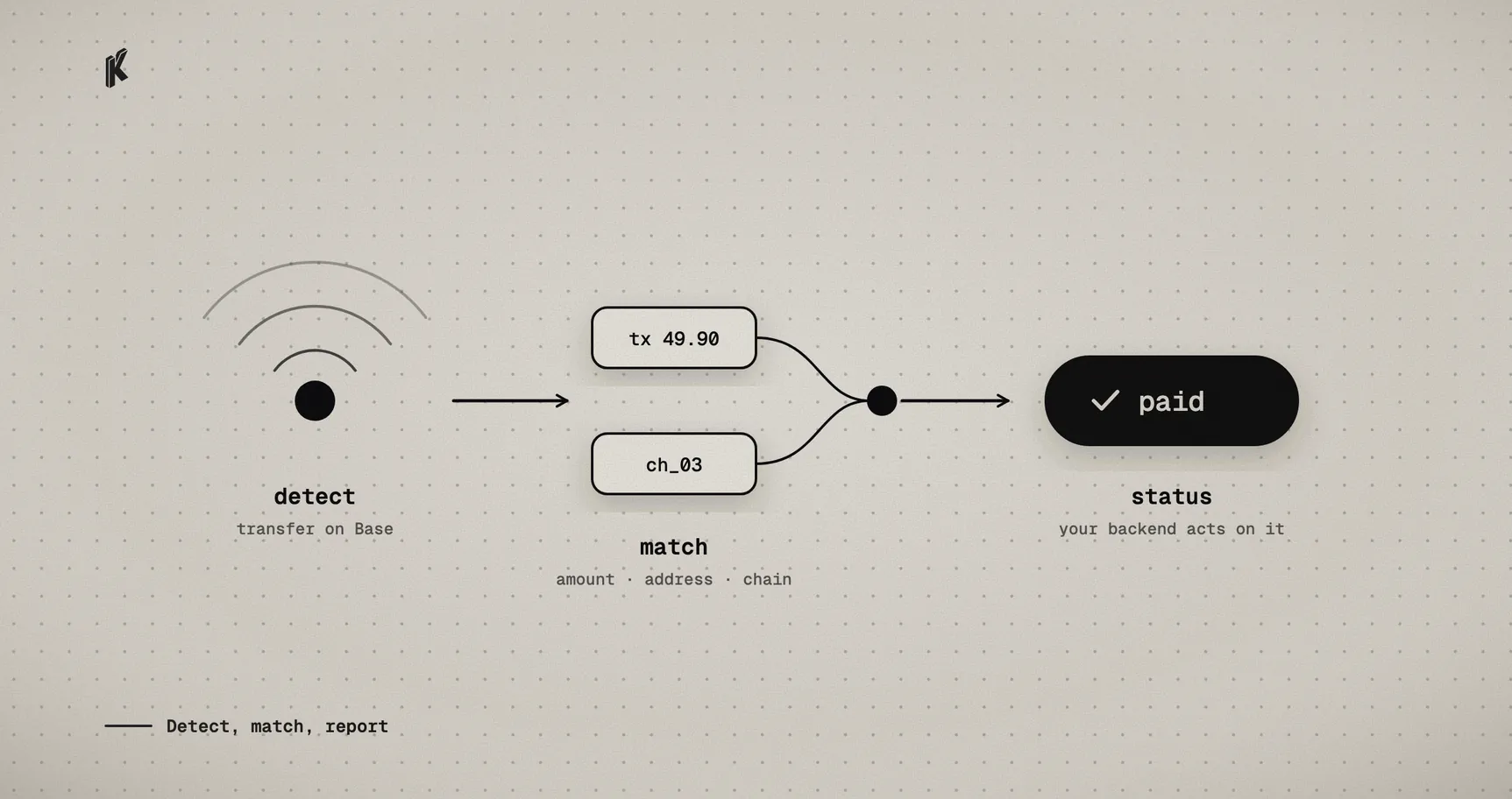
A USDC payment API is not just a way to display a wallet address at checkout. It's the boundary between a customer sending money on-chain and your application deciding whether an order, invoice, or payout is actually settled. Get that boundary wrong and you inherit address-reuse problems, delayed fulfillment, reconciliation gaps, and possibly a processor sitting between your business and its funds.
For teams building on Base and similar networks, USDC solves a real commercial problem: customers pay in a dollar-denominated asset without card rails, chargeback exposure, or multi-day settlement windows. But the asset is only one part of the system. The API determines whether that payment experience behaves like production infrastructure or a pile of wallet checks and cron jobs.
What a USDC payment API needs to do
At minimum, an API needs to create a payment request with an exact amount, the tokens and networks you'll accept, and an expiration policy — then get out of the way of your checkout design. Your product owns the interface. A payment provider shouldn't force your customer through a hosted page just because that's easier for the provider to build.
With Klappay, that request is a charge:
const charge = await klap.charges.create({amount: 49.0,acceptedPayments: [{ token: 'USDC', network: 'base' },{ token: 'USDC', network: 'optimism' },],expiresIn: 3600,externalRef: `order_${order.id}`,})
amount is always priced in USD. acceptedPayments is the list of token-and-network pairs you're willing to take for it — here, USDC on Base or Optimism. expiresIn is a lifetime in seconds, capped at one hour, because an open-ended payment request is a liability, not a convenience. externalRef is your own order ID, and Klappay echoes it back on the charge and on every webhook event so you never have to guess which order a payment belongs to.
The more consequential work begins after the request exists. A useful USDC payment API watches the chain for the intended transfer, checks it against the charge, and reports a status your application can act on — not a single boolean. That means distinguishing a charge that's still pending from one that's underpaid, partially paid, confirmed, or expired. Treating every incoming USDC transfer as automatically payable is how teams ship fulfillment bugs.
The API should also give you a way to attribute a payment to a specific charge without a memo field or manual matching. Klappay predicts a unique, deterministic address for every charge before it's even funded — the same address every time you ask, derived from the charge's own ID — so attribution doesn't depend on an off-chain matching ritual.
Direct settlement is the architecture decision
Many crypto payment products use a familiar processor model: the provider receives the payment, records an internal balance, and sends funds to you later. The word "settlement" gets used, but the custody model is still intermediary-first. You're trusting the provider's ledger, its withdrawal rules, and its ability to actually release your money.
That can be a fine trade for a business that explicitly wants managed custody. It's a poor default for teams building around wallets and on-chain primitives, because if the customer is already sending USDC on-chain, routing it through a processor-controlled account is an avoidable extra hop.
Klappay is built to detect and route payments without ever taking custody of merchant or customer funds. The customer pays a deterministic address tied to the charge. Klappay's infrastructure detects the transfer and validates it, but the funds never pass through an account Klappay controls — a charge settles when the money is already where it needs to be. Your treasury doesn't wait on a platform payout, your marketplace can distribute a payment among participants according to explicit rules, and if you ever migrate infrastructure, you're moving application logic, not asking a custodian to release your working capital.
The trade-off is real: your team owns wallet security, recipient configuration, and the policy for handling unusual transfers. An API should reduce that operational work without pretending the responsibility disappeared.
Build checkout around events, not polling
A browser can't be the source of truth for payment status. Customers close tabs, mobile wallets return slowly, and a transfer can land after a page has already timed out. Your backend needs an event-driven path from on-chain detection to business logic.
Klappay reports charge state two ways. Server-sent events push status changes the moment they happen, which is what an open checkout uses to move from "waiting for payment" to "payment detected" without polling your server. Webhooks are the durable path for backend processing — the one that still fires after the customer has closed the tab:
const event = klap.webhooks.constructEvent(request.rawBody,request.headers['x-klappay-signature'],process.env.KLAP_WEBHOOK_SECRET,)if (event.event === 'charge.confirmed') {await fulfillOrderOnce(event.data.id, event.id)}
event.data is the full charge object, not a thin pointer to one — event.data.id is the charge, event.event is which of the ten charge.* events you're looking at, and event.id is the ID of this specific webhook delivery. That last one matters: webhooks get retried, so store event.id and make fulfillOrderOnce refuse to run twice for the same delivery. A successful payment should never create two shipments.
Don't fulfill based on a transaction hash a client submitted from the browser. A hash proves a transaction exists. It doesn't prove it satisfies your charge — only a verified charge.confirmed event, checked against the amount and network you expected, does that.
Recipient splits should be native to the payment model
Splits are where a payment API either becomes real infrastructure or reveals itself as a checkout wrapper. Marketplaces, creator platforms, affiliates, and payroll tools all need one payment to reach more than one party. If you collect everything into a central wallet and calculate distributions afterward, you've built a reconciliation problem and, in some jurisdictions, a custody question you didn't need.
Klappay's splits are defined on the charge, before payment happens, as a reference to recipients you've already registered:
const seller = await klap.recipients.create({ address: sellerWallet, label: 'seller' })const platform = await klap.recipients.create({ address: platformWallet, label: 'platform' })const charge = await klap.charges.create({amount: 49.0,acceptedPayments: [{ token: 'USDC', network: 'base' }],expiresIn: 3600,externalRef: `order_${order.id}`,splitRecipients: [{ recipientId: seller.id, percent: 90, label: 'seller' },{ recipientId: platform.id, percent: 10, label: 'platform' },],})
A recipient is created once per wallet and reused across charges by ID — you're never passing a raw address into a charge at payment time, which means a compromised checkout request can't redirect funds to an address that was never registered. Klappay caps a single charge at five recipients, which is enough for the marketplace and revenue-share shapes this feature exists for, without turning a charge into a distribution ledger.
Decide your rounding rule up front — a 100.01 USDC payment split 90/10 leaves a remainder unit somewhere — and version any change to a recipient's payout wallet so it applies to new charges, not the one already in flight.
Evaluate APIs by failure behavior
Happy-path demos are cheap. Ask what happens when a customer pays after expiration, sends less USDC than the charge asked for, or pays on the right token but the wrong network. A production-grade API should make those states legible instead of collapsing everything into paid: true. Klappay's real charge statuses are pending, partially_paid, confirmed, expired, and underpaid — an underpayment is its own state, not a rounding error your webhook handler has to infer. Settlement — whether the payout to your recipients actually landed — is tracked separately again, as pending, completed, or failed, because a confirmed payment and a completed payout are two different facts.
You should be able to test all of that without spending real funds or waiting on a testnet faucet. Klappay's sandbox lets you call klap.sandbox.confirm(), .underpay(), .overpay(), .expire(), or .failSettlement() against a test charge and see exactly how your webhook handler behaves — the same events, the same shapes, none of the waiting. A sandbox that only ever returns success isn't a sandbox. It's a demo.
Put payment policy in your application
No USDC payment API can decide your business rules for you. Define your own confirmation thresholds where the API allows it, decide whether an underpayment opens a support flow or expires automatically, and set a clear policy for late payments and duplicate transfers before a support ticket forces the decision on you.
Then make those policies visible in your own data model. Store the charge ID, your order reference, the expected amount, the recipient configuration, and the status history — the chain is your independent record that value moved, but your application still needs a coherent record of what that movement meant.
The useful question isn't whether you can accept USDC. Any static wallet can do that. The question is whether your payment system can prove who paid, what they paid for, where the funds went, and why your application fulfilled the order. Start at klappay.com/developers and build for that standard.